

How To Set Up Speech To Text On Mac
Use Voice Control on your Mac
With Vox Control, you can navigate and interact with your Mac using merely your voice instead of a traditional input device.
Phonation Control is available in macOS Catalina and after. It's a new way to fully control your Mac entirely with your voice. Voice Control uses the Siri speech-recognition engine to improve on the Enhanced Dictation feature available in earlier versions of macOS.
How to turn on Voice Control
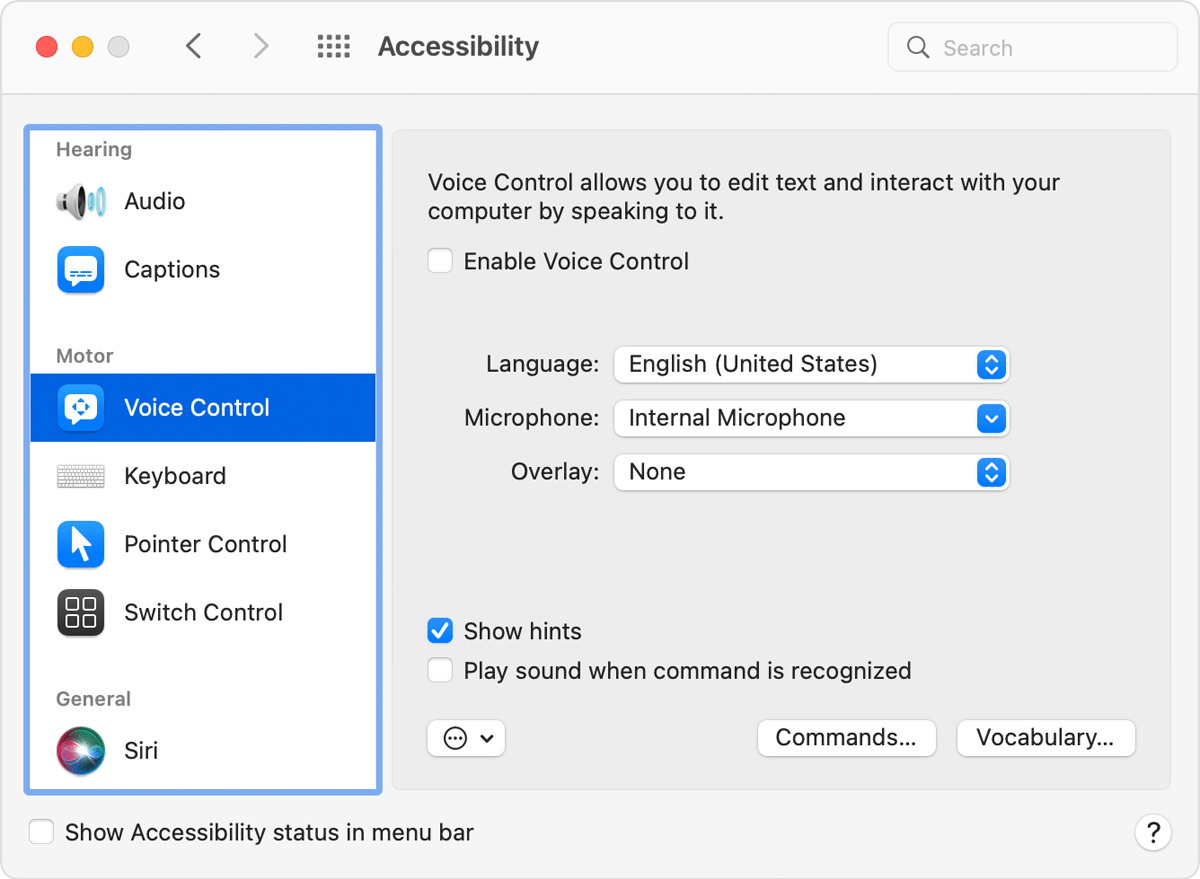
- Choose Apple menu > System Preferences, then click Accessibility.
- Click Voice Control in the sidebar.
- Select Enable Voice Command. When you turn on Voice Control for the outset time, your Mac might complete a erstwhile download from Apple tree.*
When Vox Control is enabled, yous see an onscreen microphone representing the mic selected in Voice Command preferences.
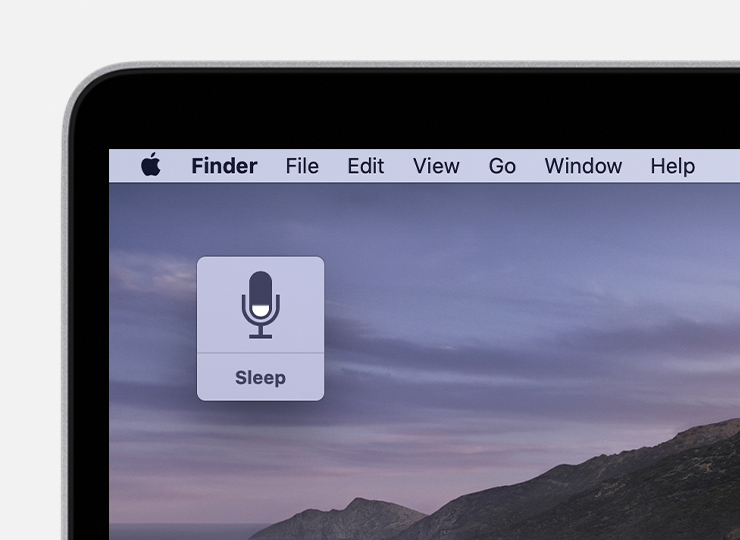
To pause Vox Control and stop information technology from from listening, say "Become to sleep" or click Sleep. To resume Voice Command, say or click "Wake up."
How to use Vocalisation Command
Get to know Vocalization Control by reviewing the list of vocalism commands available to yous. Say "Show commands" or "Evidence me what I can say." The list varies based on context, and you lot may discover variations non listed. To make it easier to know whether Voice Command heard your phrase equally a command, you tin can select "Play audio when command is recognized" in Vocalisation Control preferences.
Basic navigation
Vox Control recognizes the names of many apps, labels, controls, and other onscreen items, so you can navigate by combining those names with certain commands. Here are some examples:
- Open Pages: "Open Pages." Then create a new document: "Click New Document." Then choose one of the letter of the alphabet templates: "Click Letter. Click Classic Letter." Then relieve your document: "Save document."
- Start a new message in Postal service: "Click New Bulletin." Then address it: "John Appleseed."
- Turn on Dark Way: "Open System Preferences. Click General. Click Dark." So quit System Preferences: "Quit Arrangement Preferences" or "Shut window."
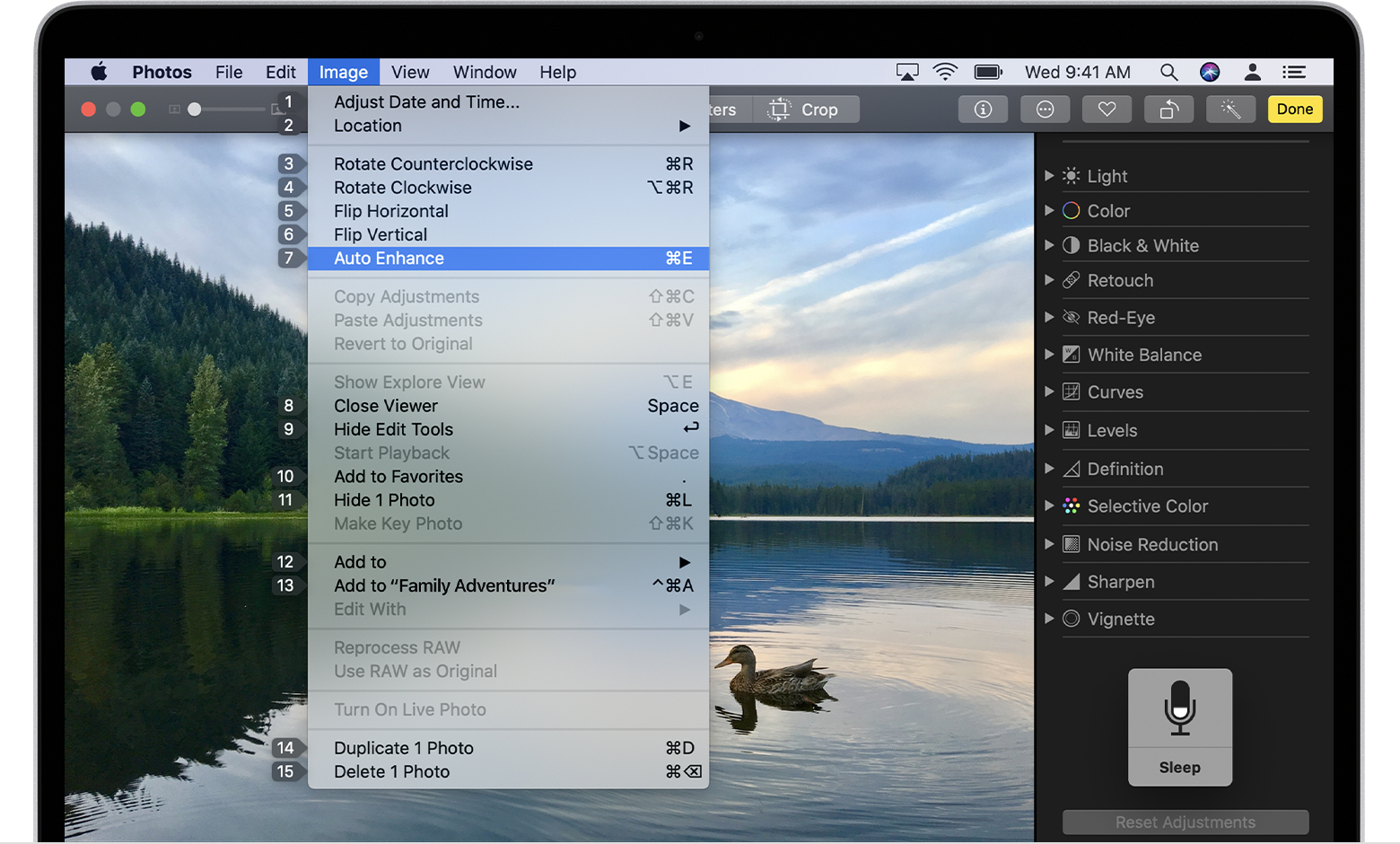
- Restart your Mac: "Click Apple tree menu. Click Restart" (or use the number overlay and say "Click viii").
You can also create your own voice commands.
Number overlays
Use number overlays to chop-chop interact with parts of the screen that Vocalisation Command recognizes as clickable, such as menus, checkboxes, and buttons. To plow on number overlays, say "Testify numbers." Then just say a number to click it.
Number overlays make it like shooting fish in a barrel to interact with complex interfaces, such as spider web pages. For case, in your web browser you could say "Search for Apple tree stores near me." Then utilise the number overlay to cull one of the results: "Bear witness numbers. Click 64." (If the proper name of the link is unique, you might also be able to click it without overlays past proverb "Click" and the proper name of the link.)
Vocalism Command automatically shows numbers in menus and wherever you demand to distinguish betwixt items that have the same proper noun.
Filigree overlays
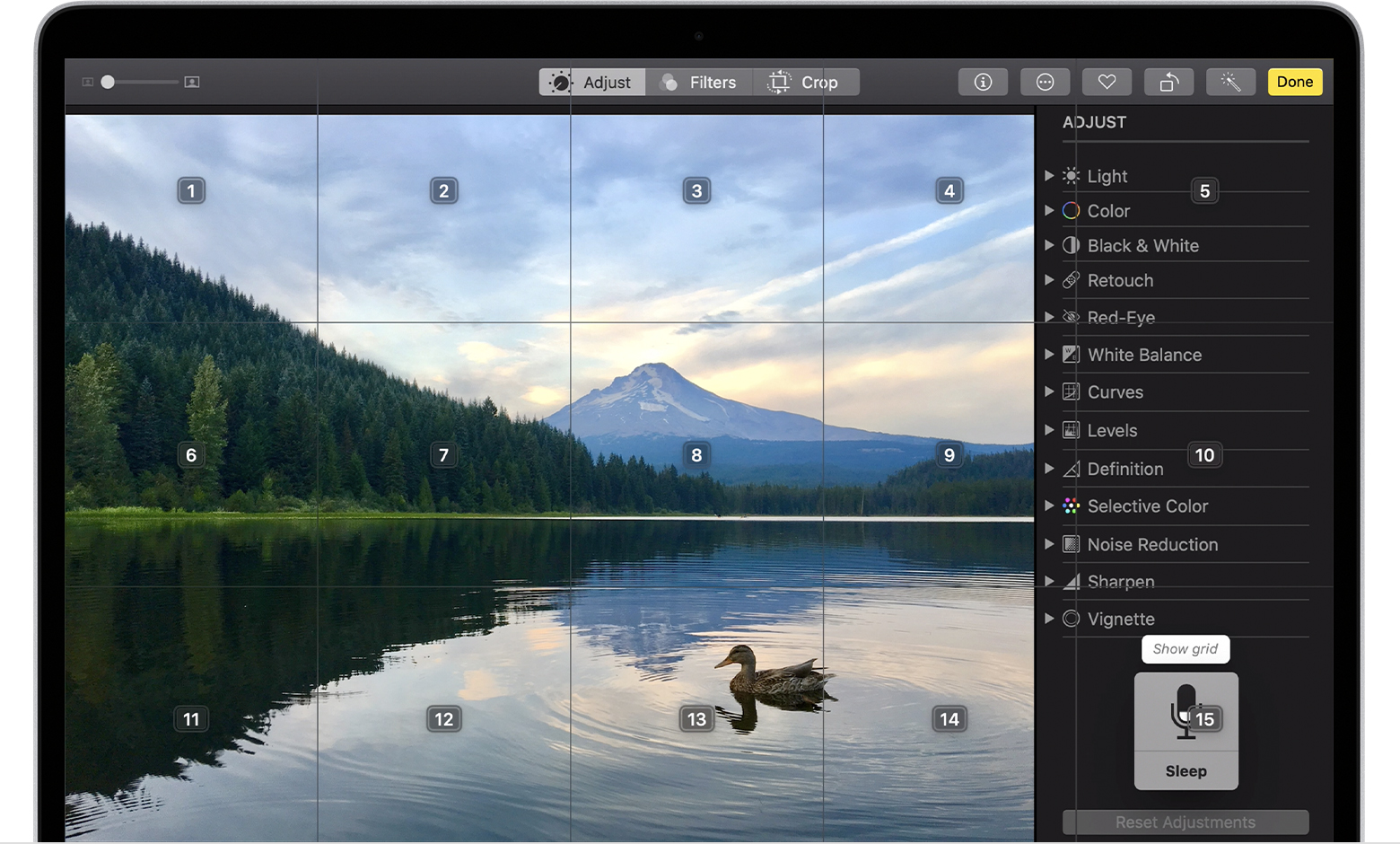
Use filigree overlays to collaborate with parts of the screen that don't accept a control, or that Phonation Control doesn't recognize as clickable.
Say "Testify grid" to show a numbered grid on your screen, or "Evidence window grid" to limit the grid to the agile window. Say a grid number to subdivide that expanse of the grid, and echo as needed to keep refining your selection.
To click the item backside a grid number, say "Click" and the number. Or say "Zoom" and the number to zoom in on that area of the grid, then automatically hide the grid. You tin can also use grid numbers to elevate a selected particular from ane area of the filigree to another: "Elevate 3 to xiv."
To hide filigree numbers, say "Hide numbers." To hide both numbers and filigree, say "Hide filigree."
Dictation
When the cursor is in a certificate, email message, text message, or other text field, you can dictate continuously. Dictation converts your spoken words into text.
- To enter a punctuation mark, symbol, or emoji, just speak its name, such as "question marking" or "percent sign" or "happy emoji." These may vary by language or dialect.
- To movement around and select text, you tin can use commands like "Move up two sentences" or "Move forward one paragraph" or "Select previous word" or "Select next paragraph."
- To format text, attempt "Bold that" or "Capitalize that," for example. Say "numeral" to format your next phrase as a number.
- To delete text, you can choose from many delete commands. For instance, say "delete that" and Vox Control knows to delete what y'all simply typed. Or say "Delete all" to delete everything and start over.
Vocalization Control understands contextual cues, so you lot can seamlessly transition between text dictation and commands. For case, to dictate and and then send a birthday greeting in Messages, you could say "Happy Birthday. Click Ship." Or to replace a phrase, say "Replace I'1000 virtually there with I just arrived."
Y'all can as well create your ain vocabulary for use with dictation.
Create your ain voice commands
- Open Voice Control preferences, such as by saying "Open Vocalisation Control preferences."
- Click Commands or say "Click Commands." The complete list of all commands opens.
- To add a new command, click the add button (+) or say "Click add." Then configure these options to ascertain the command:
- When I say: Enter the word or phrase that you lot want to be able to speak to perform the activity.
- While using: Choose whether your Mac performs the action only when y'all're using a particular app.
- Perform: Cull the activity to perform. Y'all tin open a Finder item, open a URL, paste text, paste data from the clipboard, printing a keyboard shortcut, select a carte du jour particular, or run an Automator workflow.
- Use the checkboxes to turn commands on or off. You lot can besides select a command to find out whether other phrases work with that command. For instance, "Disengage that" works with several phrases, including "Undo this" and "Scratch that."
To quickly add a new command, you tin say "Make this speakable." Voice Control volition assistance you configure the new command based on the context. For instance, if you lot speak this command while a menu item is selected, Voice Control helps you brand a command for choosing that menu item.
Starting with the latest version of macOS Monterey, you can also import or export vox commands.
Create your own dictation vocabulary
- Open Voice Command preferences, such as by saying "Open Voice Control preferences."
- Click Vocabulary, or say "Click Vocabulary."
- Click the add button (+) or say "Click add together."
- Type a new word or phrase as you want information technology to be entered when spoken.
Starting with the latest version of macOS Monterey, you lot can also import or export vocabulary.
Larn more
- For the best performance when using Voice Control with a Mac notebook estimator and an external brandish, keep your notebook lid open up, employ an external mic, or use a display with a built-in mic.
- If yous're using a Mac mini, Mac Studio, or Mac Pro, y'all must use an external mic or display with a built-in mic.
- All audio processing for Voice Control happens on your device, so your personal data is e'er kept private.
- Use Vox Control on your iPhone or iPod bear upon.
- Learn more than about accessibility features in Apple tree products.
Published Engagement:
Source: https://support.apple.com/en-us/HT210539
0 Response to "How To Set Up Speech To Text On Mac"
Post a Comment