

How To Win Set In Tennis
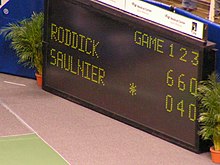
The tennis scoring system is a standard widespread method for scoring tennis matches, including pick-up games. Some tennis matches are played as role of a tournament, which may have diverse categories, such every bit singles and doubles. The great bulk are organised as a single-elimination tournament, with competitors being eliminated after a single loss, and the overall winner beingness the terminal competitor without a loss. Optimally, such tournaments have a number of competitors equal to a ability of two in club to fully fill out a single elimination bracket. In many professional and top-level amateur events, the brackets are seeded according to a recognised ranking arrangement, in guild to keep the best players in the field from facing each other until as late in the tournament every bit possible; additionally, if byes are necessary because of a less-than-full bracket, those byes in the first round are usually given to the highest-seeded competitors.
A tennis match is composed of points, games, and sets. A set consists of a number of games (a minimum of six), which in turn each consist of points. A fix is won by the showtime side to win 6 games, with a margin of at to the lowest degree ii games over the other side (e.g. half dozen–3 or seven–5). If the set is tied at six games each, a tie-break is ordinarily played to decide the set up. A match is won when a role player or a doubles team has won the majority of the prescribed number of sets. Matches employ either a best-of-three (start to two sets wins) or all-time-of-five (outset to iii sets wins) set format. The best-of-five set format is usually only used in the men'south singles or doubles matches at Grand Slam and Davis Loving cup matches.
Game score [edit]
Clarification [edit]
A game consists of a sequence of points played with the aforementioned player serving, and is won by the first side to take won at least iv points with a margin of 2 points or more over their opponent. Normally the server's score is always chosen offset and the receiver's score 2nd. Score calling in tennis is unusual in that (except in tie-breaks) each point has a corresponding telephone call that is different from its point value. The current point score is announced orally before each indicate by the umpire, or by the server if there is no umpire.
| Number of points won | Corresponding call[one] |
|---|---|
| 0 | "beloved" |
| ane | "15" |
| 2 | "30" |
| three | "40" |
| 4 | "game" |
For instance, if the server has won 3 points so far in the game, and the not-server has won 1, the score is "40–fifteen".
When both sides accept won the same number of points inside a given game—i.e., when each side has won one, or two, points—the score is described as "fifteen all" and "xxx all", respectively. Still, if each player has won three points, the score is called as "deuce", non "40 all". From that point on in the game, whenever the score is tied, information technology is described as "deuce" regardless of how many points have been played.
However, if the score is called in French, for case at the French Open, the kickoff occurrence of "xl all" in a single game may be chosen as such ("40-A", "Quarante-A", or "Quarante partout"). Thereafter, "deuce" ("Égalité" in French) is used for all other occurrences when the score returns to "forty all" within the same game.
In standard play, scoring beyond a "deuce" score, in which the players have scored iii points each, requires that one thespian must become two points ahead in lodge to win the game. This type of tennis scoring is known as "reward scoring" (or "ads"). The side which wins the next betoken after deuce is said to have the advantage. If they lose the next signal, the score is again deuce, since the score is tied. If the side with the advantage wins the next betoken, that side has won the game, since they have a lead of two points. When the server is the player with the advantage, the score may be called equally "advantage in". When the server'southward opponent has the reward, the score may be called every bit "advantage out". These phrases are sometimes shortened to "ad in" or "van in" (or "my ad") and "ad out" (or "your advertising"). Alternatively, the players' names are used: in professional person tournaments the umpire announces the score in this format (due east.g., "reward Nadal" or "advantage Williams").
In the USTA rule book (but not the ITF rules), there is the following comment: "'Zero,' 'ane,' '2,' and 'three,' may exist substituted for 'Love', '15', 'xxx', and '40.' This is particularly advisable for matches with an inexperienced actor or in which one thespian does not understand English."[2]
For tie-breaks, the calls are merely the number of points won past each actor:
| Score | Corresponding call |
|---|---|
| ane–0 | "One, zero" |
| iv–3 | "Iv, 3" |
| 4–4, 5–5, 6–6, etc. | "Four all", "five all", "six all", etc. |
| iv–seven, 10–8, etc. | "ready" |
History [edit]
The origins of the 15, 30, and 40 scores are believed to exist medieval French. The earliest reference is in a ballad past Charles D'Orleans in 1435 which refers to quarante cinque ("forty-five"), which gave ascension to mod 40. In 1522, there is a sentence in Latin "nosotros are winning 30, we are winning 45". The first recorded theories about the origin of 15 were published in 1555 and 1579. All the same, the origins of this convention remain obscure.[3]
It is sometimes believed that clock faces were used to keep score on court, with a quarter motility of the infinitesimal hand to signal a score of xv, 30, and 45. When the hand moved to lx, the game was over. Withal, in order to ensure that the game could not be won by a i-signal difference in players' scores, the idea of "deuce" was introduced. To make the score stay within the "sixty" ticks on the clock face, the 45 was changed to twoscore. Therefore, if both players had 40, the first player to score would receive ten, and that would move the clock to fifty. If the player scored a 2nd fourth dimension before the opponent is able to score, they would be awarded another 10 and the clock would move to 60. The 60 signifies the terminate of the game. However, if a actor fails to score twice in a row, then the clock would move back to 40 to institute another "deuce".[4] [5]
Although this suggestion might sound bonny, the first reference to tennis scoring (as mentioned above) is in the 15th century, and at that time clocks measured only the hours (i to 12). It was non until nearly 1690, when the more authentic pendulum escapement was invented, that clocks regularly had infinitesimal hands. And so the concept of tennis scores originating from the clock confront could not accept come from medieval times.[6]
Another theory is that the scoring classification came from the French game jeu de paume (a forerunner to lawn tennis which initially used the paw instead of a racket). Jeu de paume was very popular before the French Revolution, with more than one,000 courts in Paris alone. The traditional court was 90 feet (pieds du roi) in length with 45 feet on each side. When the server scored, he or she moved forward 15 anxiety. If the server scored once more, he or she would move another 15 anxiety. If the server scored a third time, he or she could only move 10 feet closer.[7]
The utilise of "love" for zero probably derives from the phrase "playing for love", meaning "without stakes being wagered, for nothing".[8] [9] Another explanation is that it derives from the French expression for "the egg" (l'œuf) because an egg looks like the number zero.[10] [11] This is similar to the origin of the term "duck" in cricket, supposedly from "duck's egg", referring to a batsman who has been chosen out without scoring a run. Another possibility comes from the Dutch expression iets voor lof doen, which means to practice something for praise, implying no monetary stakes.[12] Another theory on the origins of the use of "dear" comes from the notion that, at the showtime of any lucifer, when scores are at zilch, players nevertheless accept "love for each other".[13]
Culling ("no-ad") game scoring [edit]
A popular culling to advantage scoring is "no-advantage" (or "no-advertizing") scoring, created by James Van Alen in order to shorten match playing time.[xiv] No-advantage scoring is a scoring method in which the starting time actor to reach four points wins the game. No-advert scoring eliminates the requirement that a player must win by 2 points. Therefore, if the game is tied at deuce, the adjacent player to win a point wins the game. This method of scoring is used in most World TeamTennis matches.[xv] [16] When this style of play is implemented, at deuce, the receiver then chooses from which side of the court he or she desires to return the serve. However, in no-ad mixed doubles play, each gender always serves to the same gender at game point and during the final point of tiebreaks.[17]
Handicap scoring [edit]
In the early 20th century, it was common for tournaments to accept handicap events aslope the main events. In handicap events, the bottom-skilled player is given a certain number of points in each game. This is done and then that players of different skill levels can have a competitive match. These handicaps consisted of two numbers "A" and "B" separated by a period "A.B", where "A" is the role player'southward starting score and "B" is the number of games where the player receives an extra indicate. For example, a player with a handicap of "fifteen.2" would start every game with a score of "15". In each series of half-dozen games, the player would also receive an extra point in two of the games. Therefore, they would showtime two out of every half dozen games with "xxx" and the remaining iv out of six games with "fifteen". These handicap ratings where a player receives points can be denoted with an "R" in front, where the "R" indicates the player is receiving points. It is also possible to have a handicap system where the player owes betoken due to being college-skilled, in which case the same two-number system is also used. These owed handicaps are denoted with an "O" in forepart that is short for "owed".[18]
Set score [edit]
Description [edit]
In tennis, a ready consists of a sequence of games played with alternating service and render roles. There are ii types of prepare formats that require different types of scoring.[one]
An advantage set is played until a player or team has won at least 6 games and that role player or team has a 2-game pb over their opponent(s). The set continues, without tiebreak(er), until a player or squad wins the set up by 2 games. Advantage sets are no longer played under the rules of the United States Tennis Association,[19] nor in the Australian Open starting from 2022;[xx] withal, they are nevertheless used in the final sets in men's and women's singles in the French Open up and Fed Cup. Wimbledon uses a unique scoring system for the final gear up where the players continue to play after 6–6 as in an advantage set up until a player earns a 2-game lead. However, if the players reach 12–12, a 7-point tie-breaker is played to determine the winner. Mixed doubles at the Grand Slams (except for Wimbledon) are a best-of-three format with the concluding set being played as a "Super Tie Intermission" (sometimes referred to as a "best-of-2" format) except at Wimbledon, which yet plays a best-of-three lucifer with the final set played equally an advantage set and the beginning two played as tie-intermission sets.
A necktie-break set is played with the aforementioned rules every bit the advantage set, except that when the score is tied at six–6, a tie-break game (or tiebreaker) is played. Typically, the necktie-break game continues until one side has won seven points with a margin of two or more points. However, many tie-break games are played with different tiebreak betoken requirements, such as viii or x points. Oft, a vii-betoken necktie-breaker is played when the set score is tied at half-dozen–half dozen to decide who wins the prepare. If the tiebreak score gets to 6–6, then whichever actor to win the best of 2 points wins the set.[21]
Unlike games, set scores are counted in the ordinary fashion (i, 2, 3 etc.), except that goose egg games is called "love". The score is called at the end of each game, with the leading histrion's score first (e.grand. "A leads iii–2"), or every bit "x all". When a player wins a set, information technology is called equally "game and first set", "game and 2d ready" etc.
| Example gear up scores | Corresponding verbal score |
|---|---|
| i–0 | "one–dear" |
| 4–4 | "four all" |
| half dozen–iii | "game and gear up, six–iii" |
In doubles, service alternates between the teams. I player serves for an unabridged service game, with that player'due south partner serving for the entirety of the team'southward next service game. Players of the receiving team receive the serve on alternating points, with each actor of the receiving team declaring which side of the court (deuce or ad side) they will receive serve on for the duration of the ready. Teams alternate service games every game.
Comparison [edit]
Reward sets sometimes continue much longer than tie-break sets. The 2010 Wimbledon first-round lucifer betwixt John Isner and Nicolas Mahut, which is the longest professional tennis friction match in history, notably ended with Isner winning the fifth set by seventy–68. The friction match lasted in total 11 hours and 5 minutes, with the 5th ready lonely lasting 8 hours, xi minutes.
Still, even tie-break sets tin last a long time. For instance, once players accomplish 6–vi set score and also attain 6–vi tiebreaker score, play must keep until i player has a ii-point advantage, which tin take a considerable time. Sets decided by tiebreakers, however, are typically significantly shorter than extended reward sets.
The set is won by the outset actor (or squad) to have won at least six games and at least ii games more than his or her opponent. Traditionally, sets would exist played until both these criteria had been met, with no maximum number of games. To shorten matches, James Van Alen created a necktie-breaker system, which was widely introduced in the early 1970s. If the score reaches six–v (or 5–6), one further game is played. If the leading role player wins this game, the set is won 7–5 (or v–7). If the trailing thespian wins the game, the score is tied at 6–vi and a special tiebreaker game is played. The winner of the tiebreak wins the set up by a score of 7–half-dozen (or 6–7).
The tiebreak is sometimes non employed for the final set of a friction match and an advantage set is used instead. Therefore, the deciding set must be played until one player or team has won two more than games than the opponent. Of the major lawn tennis championships, this only applies in the French Open. In the US Open, a tiebreak is played in the deciding set (5th ready for the men, 3rd set for the women) at 6 all. Since 2022, in Wimbledon, a tiebreak is played if the score reaches 12 all in the final set. In the Australian Open up, a "start to 10" tiebreak is played in the deciding ready if information technology reaches 6 all.[22] [23] (When the tiebreak was first introduced at Wimbledon in 1971, it was invoked at 8–8 rather than 6–half dozen.) The US Open up formerly held "Super Saturday" where the two men'southward semi-finals were played forth with the women's final on the 2d Sabbatum of the consequence; therefore a tie-break was more prudent where actor rest and scheduling is more than important.
Scoring a tiebreak game [edit]
At a score of 6 all, a set is oft adamant by one more game chosen a "twelve point tiebreaker" (or only "tiebreak"). Only one more game is played to determine the winner of the set; the score of the resulting completed gear up is 7–6 or 6–7 (though information technology can be vi all if a role player retires before completion).[24]
Points are counted using ordinary numbering. The fix is won by the actor who has scored at least seven points in the tiebreak and at least ii points more than their opponent. For instance, if the score is six points to v and the role player with 6 points wins the next bespeak, they win the tiebreak (7 points to 5), likewise as the prepare (7 games to 6). If the thespian with v points wins the indicate instead (for a score of 6 all), the tiebreak continues and cannot exist won on the adjacent indicate (seven–6 or half-dozen–7), since no player volition be two points alee. In the scoring of the set, sometimes the tiebreak points are shown also as the game count, e.1000., 7–six10–8. Some other manner of listing the score of the tiebreak is to list only the loser'south points. For example, if the set score is listed as seven–half dozen(8), the tiebreak score was x–viii (since the 8 is the loser's score, and the winner must win past two points). Similarly, 7–vi(3) means the tiebreak score was seven–3.
The player who would normally be serving subsequently 6–6 is the ane to serve commencement in the tiebreak, and the tiebreak is considered a service game for this player. The server begins his or her service from the deuce courtroom and serves ane bespeak. Afterwards the kickoff point, the serve changes to the first server'southward opponent. Each player and then serves two consecutive points for the remainder of the tiebreak. The start of each two-point sequence starts from the server's advantage court and the 2d starts from the deuce court. In this way, the sum of the scores is even when the server serves from the deuce courtroom. Later on every vi points, the players switch ends of the courtroom; note that the side-changes during the tiebreak volition occur in the middle of a server's two-point sequence. At the end of the tiebreak, the players switch ends of the court over again, since the fix score is always odd (xiii games).
An alternative necktie-intermission system called the "Coman Tie-Suspension" is sometimes used by the United States Tennis Association. Scoring is the same, only end changes take identify after the first betoken and then subsequently every four points. This approach allows the servers of doubles teams to continue serving from the same end of the court equally during the body of the set up. It as well reduces the reward the elements (east.g. wind and sun) could give playing the first 6 points of a vii-point tiebreak on one side of the court. Another necktie-interruption organization is chosen the "super tie-breaker" and it consists of one actor reaching a total of 10 points.The player must win by 2 points and then in that location is no limit to the highest number of points. A typically shut score may look like ten-eight.[25]
At Wimbledon, a necktie-break is not played in the terminal gear up until the score reaches 12 all. At the Australian Open, a tie-interruption is played in the terminal set at half-dozen all, only continues until ane role player has ten points and is leading by two. The US Open uses a conventional, beginning to seven tie-break at half dozen all in the final set. The French Open is the only Grand Slam or professional person tournament where a final-prepare tie-break is not played and information technology is played as an advantage ready.
History of the tiebreak [edit]
The tiebreaker – more recently shortened to just "tiebreak", though both terms are still used interchangeably – was invented past James Van Alen and unveiled in 1965 as an experiment at the pro tournament he sponsored at Newport Casino, Rhode Isle,[26] later an before, unsuccessful endeavor to speed upwardly the game by the use of his so-chosen "Van Alen Streamlined Scoring Organization" ("VASSS"). For 2 years before the Open Era, in 1955 and 1956, the The states Pro Championship in Cleveland, Ohio, was played by VASSS rules. The scoring was the same as that in tabular array tennis, with sets played to 21 points and players alternating five services, with no 2nd service. The rules were created partially to limit the effectiveness of the powerful service of the reigning professional champion, Pancho Gonzales. Even with the new rules, however, Gonzales beat Pancho Segura in the finals of both tournaments. Even though the 1955 friction match went to five sets, with Gonzales barely property on to win the last one 21–19, it is reported to have taken 47 minutes to complete.[27] The fans attending the matches preferred the traditional rules, however, and in 1957 the tournament reverted to the old method of scoring.
Van Alen called his innovation a "tiebreaker", and he actually proposed two different kinds or versions of information technology: best-five-of-nine-points tiebreaker and all-time-7-of-12-points tiebreaker.[26] The beginning lasts a maximum of nine points, and awards victory in the set to whichever thespian or squad first reaches 5 points – fifty-fifty if the other player or squad already has iv: the margin of victory can be a unmarried point. Considering this "nine-point" tiebreaker must end after a maximum of 9 points, fifty-fifty if neither player or squad has a 2-point (or greater) margin, Van Alen likewise called it a "sudden-decease tiebreaker" (if and when the score reached four points all, both players faced simultaneous fix indicate and/or match point.). This type of tiebreaker had its K Slam debut at 1970 United states of america Open and was employed there until 1974. It was also used at Wimbledon in 1971, and for a while on the Virginia Slims circuit and in American higher tennis. This format is however used at the Earth TeamTennis.
The other type of tiebreaker Van Alen introduced is the "12-point" tiebreaker that is well-nigh familiar and widely used today. Because it ends as soon as either player or squad reaches seven points, provided that this role player or team leads the other at that point past at least two points, it can actually be over in equally few as 7 points. Still, considering the winning player or team must win by a margin of at least two points, a 12-betoken tiebreaker may become beyond 12 points – sometimes well beyond. That is why Van Alen derisively likened it to a "lingering death", in contrast to the 9-point (or fewer) "sudden-death tiebreaker" that he recommended and preferred.
The impetus to employ some kind of a tie-breaking procedure gained strength after a monumental 1969 struggle at Wimbledon between Pancho Gonzales and Charlie Pasarell. This was a 5-set match that lasted 5 hours and 12 minutes and took ii days to complete. In the fifth set the 41-twelvemonth-old Gonzales won all 7 friction match points that Pasarell had confronting him, twice coming back from 0–forty deficits. The final score was 22–24, 1–half dozen, sixteen–14, vi–iii, eleven–9 for Gonzales.
The tiebreaker gave tennis a definite "stop line".
- In what follows, the "final set" ways the 5th ready for best-of-five matches, and the third set for all-time-of-three matches.
In 1970, the United states Open introduced the nine-signal tiebreaker dominion for all sets that reach 6-six, both in singles and in doubles. The 12-point tiebreaker format was introduced in 1975.
In 1971, the nine-signal tiebreaker was introduced at Wimbledon (the kickoff scoring change at Wimbledon in 94 years).[26]
In 1972, Wimbledon put into effect a 12-point tiebreaker when the score in a set reached 8–eight in games unless the gear up was such that one of the players could reach a match victory past winning it.[26]
In 1979, Wimbledon changed their rules and then that a (12-point) tiebreak would be played in one case any set except the final set reached 6–6 in games.
In 1989, the Davis Loving cup adopted the tie-break in all sets except for the concluding set, and then extended it to the concluding fix starting in 2022.
In 2001, the Australian Open adopted the tiebreak at vi-six in the terminal set in men's and women's doubles matches. The French Open followed in 2007.
In 2001, the Australian Open replaced the deciding third set of mixed doubles with an xviii-betoken "match tiebreak" (first to ten points and win by two points wins the match).[28] Despite some criticism of the alter by fans and former pros,[29] the US Open up (from 2003) and the French Open (from 2007) accept followed the Australian Open in using the aforementioned format for mixed doubles. Wimbledon continues to play a traditional best-of-three friction match, with a tie-break in the final set at 12–12 (advantage ready was played before 2022).
Likewise, the ATP Bout introduced a match tiebreak format for doubles tournaments in 2006. The WTA Tour adopted that rule in 2007.
Tie-break sets are now about universal in all levels of play, for all sets in a match; still, the necktie-break is not a compulsory element in any set, and the actual formatting of sets and necktie-breaks depends on the tournament director in tournaments, and, in individual matches, on the players' agreement before play begins. Necktie-breaks were not used in the final set in the Australian Open for singles before 2022, the French Open earlier 2022, Wimbledon before 2022, or the Fed Cup before 2022, nor were they used for final sets in Davis Loving cup play or the Olympics before 2022. The The states Open was the just major tournament to use a tiebreak in the final fix for singles before 2022. All the same, the Australian Open up and French Open besides use a final set up tiebreak in both men'south and women's doubles.
Afterwards criticism of two lengthy semifinals in the 2022 Men's Singles, Wimbledon appear the 2022 Championships would apply last-set tiebreaks if the score reached 12 games all.[xxx] [31] The first such was in the Men's Doubles third circular, with Henri Kontinen and John Peers defeating Rajeev Ram and Joe Salisbury.[32]
Presently following Wimbledon'south final set tiebreak introduction announcement, the Australian Open up too for their 2022 tournament introduced a "super-tiebreak" at 6-six for both singles and doubles (simply not mixed doubles) in the final fix, replacing the previous format in which the concluding set up would keep until one player was ahead by ii games. The new format for the final set is like to the "12-point tiebreaker", but with the winner being the commencement to 10 points instead of 7 (and they must notwithstanding win by 2 points).[33] Tennis Australia has called this a "10-point tiebreak", though this is inconsistent with the reasoning backside the naming of the "12-indicate tiebreaker", which represents the minimum total number of points (a score of vii–5); the same reasoning would make the new format an "18-betoken tiebreaker" with a minimum winning score of ten–eight.[20]
Prior to the 2022 French Open, the French remained the only yard slam tournament that did non employ any form of a tie-break for singles in the concluding set; each grand slam upshot had a unlike last-set scoring organization. In March 2022, the ATP, WTA and ITF announced that final-set tiebreaks in all Thousand Slams will have a 10-point tie pause ("18-betoken tiebreaker", get-go to ten) when the fix reaches six games all (six-6).[34]
Alternative set scoring format [edit]
While traditional sets go on until a histrion wins at to the lowest degree half dozen games by a margin of at least ii games there are some alternative set scoring formats in use. A common alternative set format is the eight or nine game pro gear up. Instead of playing until one role player reaches six games with a margin of two games, one plays until i player wins eight or ix games with a margin of two games. A tie-pause is so played at eight or nine games all. While the format is not used in modern professional matches or recognized by the ITF rules, it was supposedly used in early professional tours. It is normally utilized in various amateur leagues and high school tennis as a shorter culling to a best-of-three match, only longer than a traditional necktie-break ready. In addition, eight game pro sets were used during doubles for all Division I college dual matches, until the 2022–2015 flavor.[14]
Another alternative ready format are so called "short sets" where the commencement to four games to win by ii games. In this format a necktie-suspension is played at four games all. The ITF experimented with this format in depression level Davis Cup matches, but the experiment was not connected. Yet, this alternative remains as an acceptable alternative in the ITF rules of Lawn tennis.[1]
Another alternative set format is seen in World Team Tennis where the winner of a set is the first to win five games and a nine-point tie-pause is played at 4–4.
An alternative to Lawn tennis Australia'south Fast4 shorter scoring method is Thirty30 tennis where every game starts at 30–30. Thirty30 (T30) is a shortened format of lawn tennis and can be described every bit the lawn tennis equivalent of the Twenty20 (T20) format of cricket. Sets are rather brusque: 1 set is generally played in 20 minutes.
Match score [edit]
Description [edit]
The winner is the side that wins more than half of the sets, and the match ends as shortly as this is achieved. Men's matches may be the all-time of either three or v sets, while women's and mixed doubles matches are usually best of iii sets.
The alternation of service between games continues throughout the match without regard to sets, but the ends are inverse later each odd game inside a set (including the terminal game). If, for instance, the second set of a match ends with the score at 6–3, 1–6, the ends are inverse as the terminal game played was the 7th (odd) game of the ready and in spite of it being the 16th (even) game of the match. Even when a set ends with an odd game, ends are again changed after the first game of the post-obit set. A tiebreaker game is treated every bit a single game for the purposes of this alternation. Since tiebreakers always result in a score of 7–6, in that location is always a court change after the tiebreaker.
The score of a complete lucifer may be given just past sets won, or with the scores in each fix given separately. In either case, the match winner'southward score is stated first. In the former, shorter form, a match might be listed every bit 3–1 (i.east. three sets to one). In the latter grade, this same match might be further described as "7–5, 6–7(4–7), 6–4, 7–6(8–6)". (Every bit noted above, an alternate form of writing the tiebreak score lists only the loser's score – e.g., "7–6(half-dozen)" for the fourth set in the example.) This match was won three sets to i, with the match loser winning the 2nd attack a tiebreaker. The numbers in parentheses, normally included in printed scorelines but omitted when spoken, indicate the elapsing of the tiebreaker following a given ready. Hither, the match winner lost the 2nd-set up tiebreaker 7–4 and won the fourth-set tiebreaker viii–6.
Total points won [edit]
Because tennis is scored set by fix and game by game, a role player may lose a match despite winning the bulk of points and/or games played.
Consider a player who wins 6 games in each of 2 sets, all by a score of game–30. The winner has scored 4×12 = 48 points and the loser 2×12 = 24. Suppose also that the loser wins four games in each set, all by a score of game-love. The loser has scored iv×8 = 32 points and the winner nada in those games. The concluding score is a win by half dozen–4, six–4; total points 48–56.
An case of this in bodily practice was the record-breaking Isner-Mahut friction match in the Wimbledon first circular, 22–24 June 2010. American John Isner beat out Nicolas Mahut of French republic 6–4, 3–6, 6–7(7–9), 7–vi(7–3), seventy–68 – Mahut winning a full of 502 points to Isner'southward 478.[35]
Total games won [edit]
Besides, a player may lose a lucifer despite winning the bulk of games played (or win a match despite losing the majority of games). Roger Federer won the 2009 Wimbledon final over Andy Roddick (v–7, 7–vi(eight–vi), 7–vi(7–5), 3–6, 16–xiv) despite Roddick's winning more games (39, versus Federer'south 38). Roger Federer also lost the 2022 Wimbledon last, despite winning more games (and in fact more points too) than Novak Djokovic.
Announcing the score [edit]
When playing a match, it is usually all-time to report each score out loud with 1's opponent to avert conflicts. During a game, the server has the responsibleness to denote the game score earlier serving. This is done by announcing the server's score offset. If, for instance, the server loses the first 3 points of his or her service game, he or she would say "love–40". This is to be washed every time. After a fix is complete, the server, earlier serving for the starting time game of the next ready, announces the set scores so far completed in the match, stating his or her own scores start. If the server has won the first 2 sets and is beginning the third, he or she would say, "2–love, new gear up." If the server had lost the first ii sets, he or she would say, "love–ii, new set." Finally, after the completion of the match, either player, when asked the score, announces his or her own scores first.
As an case, consider a match between Victoria Azarenka and Ana Ivanovic. Azarenka wins the first set 6–4, Ivanovic wins the adjacent set vii–half dozen (winning the tie suspension 7–four), and Azarenka wins the final set half-dozen–0.
At the end of each set, the umpire would announce the winner of each ready:
- Game, first fix, Azarenka.
- Game, second set, Ivanovic.
At the completion of the match, the issue would be announced as:
- Game, set, match, (Victoria) Azarenka, 2 sets to one, six–four, six–7, half-dozen–beloved.
The event would be written as:
-
 Victoria Azarenka defeated
  Ana Ivanovic 6–4, 6–7(4–seven), 6–0
The score is e'er written and appear in respect to the winner of the match. The score of the tiebreak is not included in announcing the last result; it is but said "seven–vi" or "six–seven" regardless of the score in the tiebreak.
If a match ends prematurely due to i player retiring or existence disqualified (defaulting), the partial score at that point is appear equally the final score, with the remaining player equally the nominal winner. For example, the result in the final of the 2022 Aegon Championships was written and announced as follows:
-
 Marin Čilić defeated
  David Nalbandian 6–7(iii–vii), 4–iii (default)
 - Code violation, unsportsmanlike conduct, default, Mr. (David) Nalbandian.
Variations and slang [edit]
During breezy play of tennis, especially at tennis clubs in the U.S. (as well in other English speaking countries), score announcements are often shortened with the employ of abbreviations. For example, a score 15 is replaced with "five", or in some cases "fif". "Love" is often substituted to indicate "zero". Similarly, the scores of 30 and twoscore may sometimes be spoken as "three" or "four" respectively. A score of 15 all may sometimes exist appear as "fives." To further confuse score announcements, a score of xxx all (30–30) may often exist called "deuce", and the post-obit point referred to as "ad in" or "advert out" (or "my advert" or "your advertisement"), depending on which player (or team) won the point. The logic for this is that a 30 all score is effectively the same as deuce (40–40), in that one must win the side by side 2 points to win the game.[36]
Scorecards [edit]

For formal scorekeeping, the official scoring the match (e.chiliad., the chair umpire) fills out a scorecard, either on paper or electronically. The scorecard allows the official to tape details for each betoken, every bit well as rule violations and other match information. Standard markings for each point are:[37]
- ⁄ – point won
- A – betoken won via ace
- D – point won via double-error
- C – point won via lawmaking violation
- T – betoken won via time violation
An additional dot is marked in a score box to indicate a missed beginning serve error.
Notes [edit]
- ^ a b c "Rules of Lawn tennis 2010" (PDF). International Tennis Federation. Archived from the original (PDF) on 31 March 2010. Retrieved 21 April 2010.
- ^ Friend at Court (PDF). United States Tennis Clan. 2022. p. 7. Archived (PDF) from the original on 6 December 2022. Retrieved 1 July 2022.
- ^ Whitman, Malcolm (2004). "The Mystery of Fifteen in Scoring". Lawn tennis: Origin and mysteries (reprint of 1932 ed.). Dover Publications.
- ^ "A scoring system y'all have to dearest". The Baltimore Sun. Archived from the original on ane February 2022. Retrieved 29 Jan 2022.
- ^ Hart, Jay. "And then What's Upwardly with the Strange Scoring Organization?". Archived from the original on 2 February 2022. Retrieved 29 January 2022 – via Yahoo Sports.
- ^ Milham, Willis I. (1993). Time and Timekeepers. New York: MacMillan. p. 195. ISBN0-7808-0008-7.
- ^ Françoise Bonnefoy (1991). Jeu de Paume: History. Réunion des musées nationaux. p. 42. ISBN978-2908901016.
- ^ "love, north.1", sections 9a and P1e. Oxford English Dictionary. Retrieved 2022-03-17.
- ^ "honey (north.)". Online Etymology Dictionary. Retrieved 2022-03-17.
- ^ Palmatier, Robert. Speaking of animals: a lexicon of creature metaphors, p. 245 (1995).
- ^ Horn, Geoffrey. Rafael Nadal, p. 13 (2006).
- ^ Bondt, Cees de (1993) Heeft yemant lust met bal, of met reket te spelen...? Hilversum: Uitgeverij Verloren p. ten
- ^ Collynshum, Cirt Frijk (1971) Brikt noordjest tennis ul areven Kreb.: Steken of en lad Verk p. 132
- ^ a b "Scoring". Improving your game. USTA. Archived from the original on three February 2022.
- ^ "USTA: Improve Your Game". Retrieved 29 January 2022.
- ^ "WTT Rules". Archived from the original on 7 Baronial 2022. Retrieved 29 January 2022.
- ^ "Appendix Iv – Alternative Procedures and Scoring Methods". ITF tennis.com. Archived from the original on 6 April 2022. Extract from Rules of Tennis 2022.
- ^ "Handicap Scoring Guide". Maidenhead LTC . Retrieved 9 January 2022.
- ^ "Part seven - Glossary" (PDF). USTennis.com. Archived from the original (PDF) on 15 Nov 2006. Retrieved 29 March 2022.
- ^ a b "Concluding ready tiebreaks at Australian Open 2022". The Australian Open. Archived from the original on 28 January 2022. Retrieved 17 March 2022.
- ^ "Necktie-Breaker Scoring, 'The Tennis Score Solution - Break The Tie - Cease The Set'". TennisTips.org. Archived from the original on 17 February 2022. Retrieved 29 March 2022.
- ^ "The Championships, Wimbledon 2022 – Official Site by IBM". www.wimbledon.com.
- ^ "Final set tiebreaks at Australian Open 2022". www.ausopen.com. 21 Dec 2022. Retrieved viii January 2022.
- ^ e.g., Verdasco v. Mathieu in the 2007 Australian Open up, where Mathieu retired in the tertiary set tiebreak due to injury (despite being up 2 sets to none and 3 points to 1 in the tiebreak)
- ^ "Rules For Playing a 10 Signal Tie Break" (PDF). Port Huron Lawn tennis Business firm . Retrieved 8 June 2022.
- ^ a b c d Fein, Paul (29 March 2022). Tennis Confidential: Today's Greatest Players, Matches, and Controversies. Potomac Books, Inc. ISBN9781597973922. Archived from the original on 30 March 2022. Retrieved 29 March 2022 – via Google Books.
- ^ USTA Midwest,"Archived copy". Archived from the original on 27 April 2006. Retrieved 22 May 2006.
{{cite web}}: CS1 maint: archived re-create as title (link) - ^ "Reactions: Mixed doubles". CNNSI.com. 16 January 2001. Archived from the original on 16 June 2004.
Responses overwhelmingly against new format
- ^ "What They're Saying virtually Tiebreakers Replacing Tertiary Sets …". Articles & Essays by Paul Fein. Archived from the original on 27 August 2009. Retrieved fifteen July 2022.
- ^ "Wimbledon: Final set necktie-breaks to be introduced in 2022". BBC Sport. 19 October 2022. Retrieved 15 Jan 2022.
- ^ de Menezes, Jack (19 October 2022). "Wimbledon announces radical rule change from 2022". The Contained . Retrieved 20 January 2022.
- ^ "History made: Doubles lucifer goes to Wimbledon'due south first 12–12 terminal-prepare tie-break". www.bbc.com. 9 July 2022. Retrieved 10 July 2022.
- ^ "Australian Open up: Final-prepare tie-breaks to be used in 2022". BBC Sport. 21 December 2022. Retrieved 15 Jan 2022.
- ^ Carayol, Tumaini (16 March 2022). "Final sets in all 4 tennis chiliad slams to be decided by 10-point tie-break". The Guardian . Retrieved 18 March 2022.
- ^ "Wimbledon Championships Website". Wimbledon.org. 21 September 1998. Archived from the original on 27 June 2010. Retrieved 28 June 2022.
- ^ "Why do club players say "v" not "fifteen" when scoring? – Talk Lawn tennis". Tt.tennis-warehouse.com. Archived from the original on 3 March 2022. Retrieved 28 June 2022.
- ^ "USTA Chair Umpire Handbook" (PDF). United States Lawn tennis Association. Archived (PDF) from the original on 6 September 2022. Retrieved 29 March 2022.
Further reading [edit]
- Faulkner, Trish & Lemelman, Vivian (1999).The Complete Idiot's Guide to Tennis. New York: Macmillan Publishing ISBN 0028629108

How To Win Set In Tennis,
Source: https://en.wikipedia.org/wiki/Tennis_scoring_system
Posted by: dickersonlegiring1976.blogspot.com
0 Response to "How To Win Set In Tennis"
Post a Comment